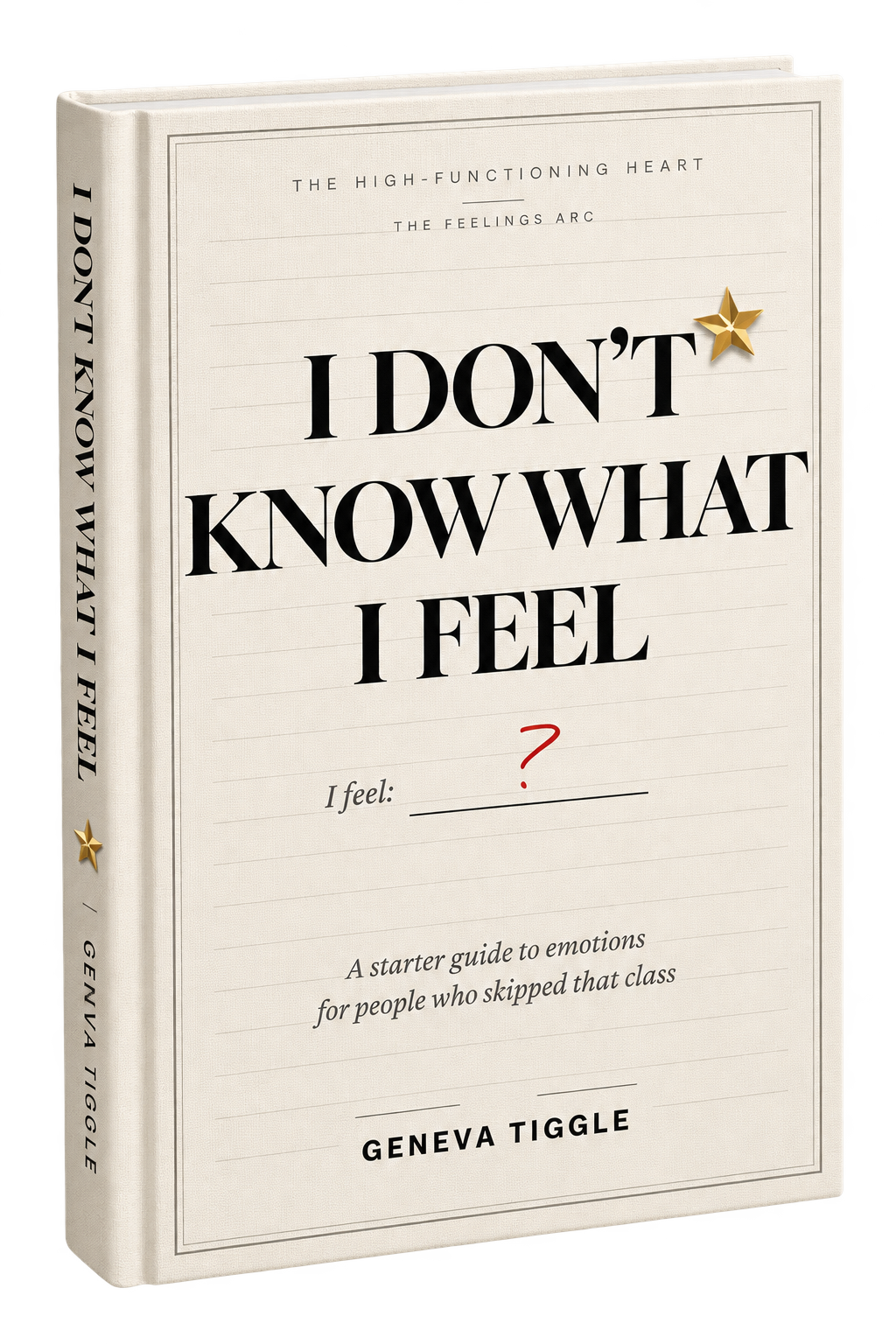
Read the first chapter
Chapter 1: This Is Not Remedial
Before we learn a single feeling, we need to deal with the voice in your head that's already grading you.
You know the one. It clocked the title of this book — a starter guide, really? — and it's been muttering ever since. It says things like: Other people just know this stuff. You're a grown adult who runs teams and households, and you need a picture book for feelings. Embarrassing. That voice thinks this is remedial education. That voice believes everyone else got the material naturally, and you alone are showing up decades late with a permission slip.
So let's establish the actual facts, because that voice is working from bad data.
Nobody "just knows" this stuff. The people who seem fluent in feelings learned it the same way anyone learns anything — through thousands of small teaching moments. Somewhere in their childhood, more often than in yours, an adult did the thing: knelt down, looked at a crying kid, and said "You seem really disappointed. You wanted to go and the plan changed. That's hard." That sentence looks like nothing. It's actually a complete lesson: it detects the feeling, names it, connects it to a cause, and declares it survivable. Run that lesson a few thousand times across a childhood and you get an adult who can answer "what are you feeling?" the way you answer "what's seven times eight?" — instantly, without ceremony.
Now here's what happened at your house instead. When feelings showed up, they got handled some other way. Maybe they got fixed: don't cry, here, we'll get another one. Maybe they got dismissed: you're fine, you're okay, up you go. Maybe they got outperformed: the family paid attention to grades and games and accomplishments, and feelings simply had no slot in the schedule. Maybe they got punished, or maybe — commonest of all — the adults around you had never taken the class themselves, and you can't teach a language you don't speak. Whatever the mechanism, the lessons didn't run. Not because you were unteachable. Because school was never in session.
And here's the part that voice in your head really needs to hear: you didn't fall behind. You specialized. While other kids were getting feeling-lessons, you were getting other lessons — achievement, self-reliance, reading the room, not being a burden. You aced that curriculum. You are, in fact, over-educated in it. The skills you're missing aren't beneath you; they're simply elsewhere — a subject your school never offered, sitting exactly where it's always been, waiting for enrollment.
I want to give you a new frame for this whole project, and I want you to actually try it on, because the frame determines whether you finish this book. The old frame says: learning emotions as an adult is remedial, embarrassing, evidence of damage. The new frame says: learning emotions as an adult is a second language. That's not a soft metaphor; it's practically literal. You're acquiring vocabulary, grammar, and listening comprehension for a language that was spoken around you but never to you. And nobody sneers at an adult learning a second language. We say: good for you. We say: it's harder as an adult, the accent never fully goes away, and fluency is absolutely achievable anyway.
Your accent, for the record, will be permanent. Twenty years from now, your first reflex under pressure will still be I'm fine, let's focus on the plan. Fluency doesn't mean losing the reflex. It means catching it — noticing the reflex fire, and choosing, sometimes, to say the truer thing instead. That catch is the whole skill. This book teaches the catch.
One more thing about the voice that thinks this is embarrassing. Notice — first detection exercise of the class — that the voice itself is a feeling wearing a costume. Underneath "this is remedial" is something softer: the fear of being a beginner. You've organized your entire adult life around never being a beginner in public. And here you are, page one of a starter guide, being one.
That's not embarrassing. In my class, that's the most advanced thing in the room.
Say it out loud
"I'm not behind. I was never enrolled — and now I am."